Honda and Acura's national summer service campaign — 36 animated ads, personalized for 1,012 dealerships — produced by one person directing an AI studio. Expert-grade code from the machine. A studio in a chair.
Two brands. Six IAB sizes. Two animated creative concepts plus a static retargeting cut. And the hard part: every one of 1,012 dealerships — 784 Honda, 228 Acura — needed its own name stitched into the creative. The traditional answer is a production team and a few weeks. This was one person, one chair, and an AI production line.
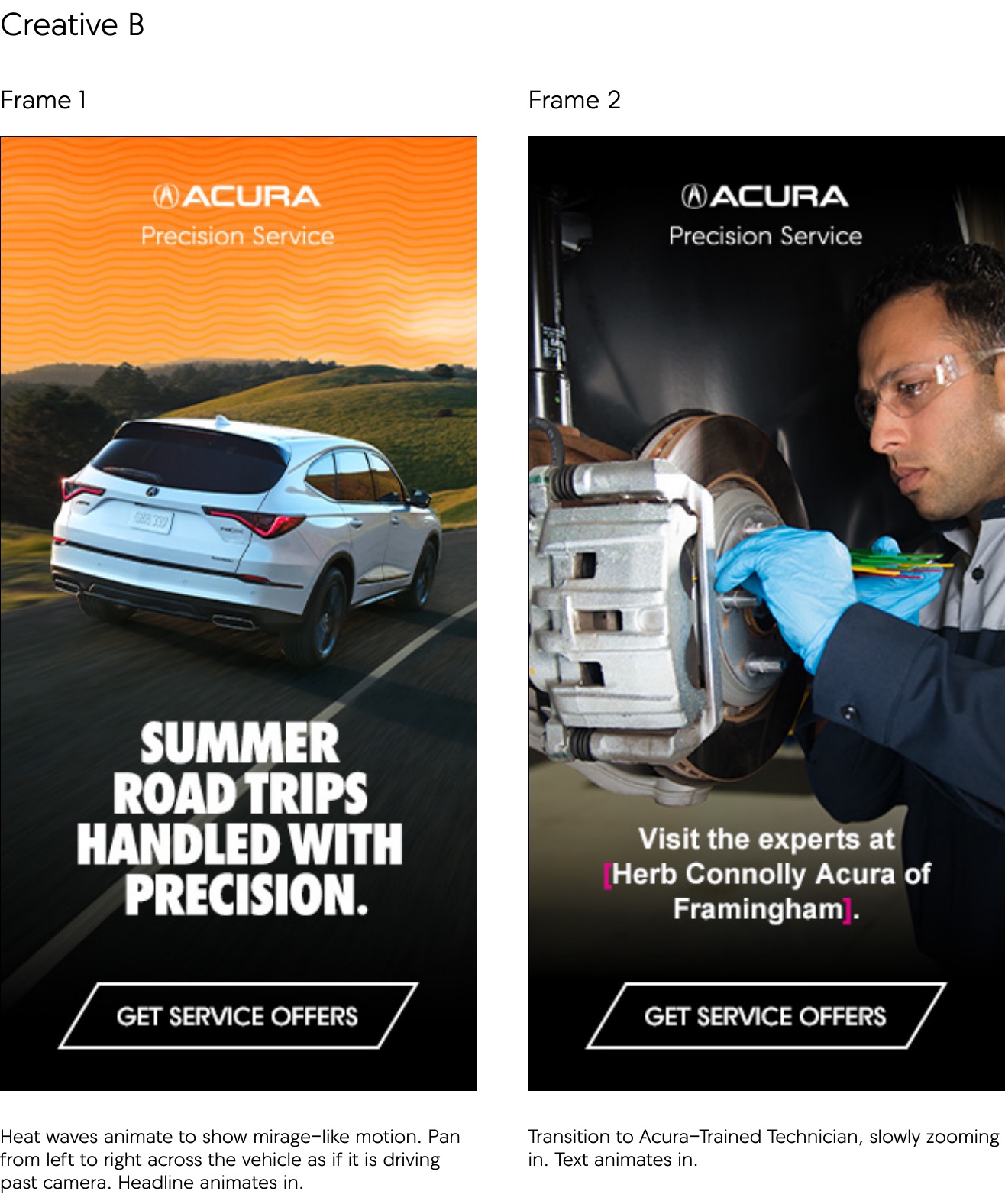
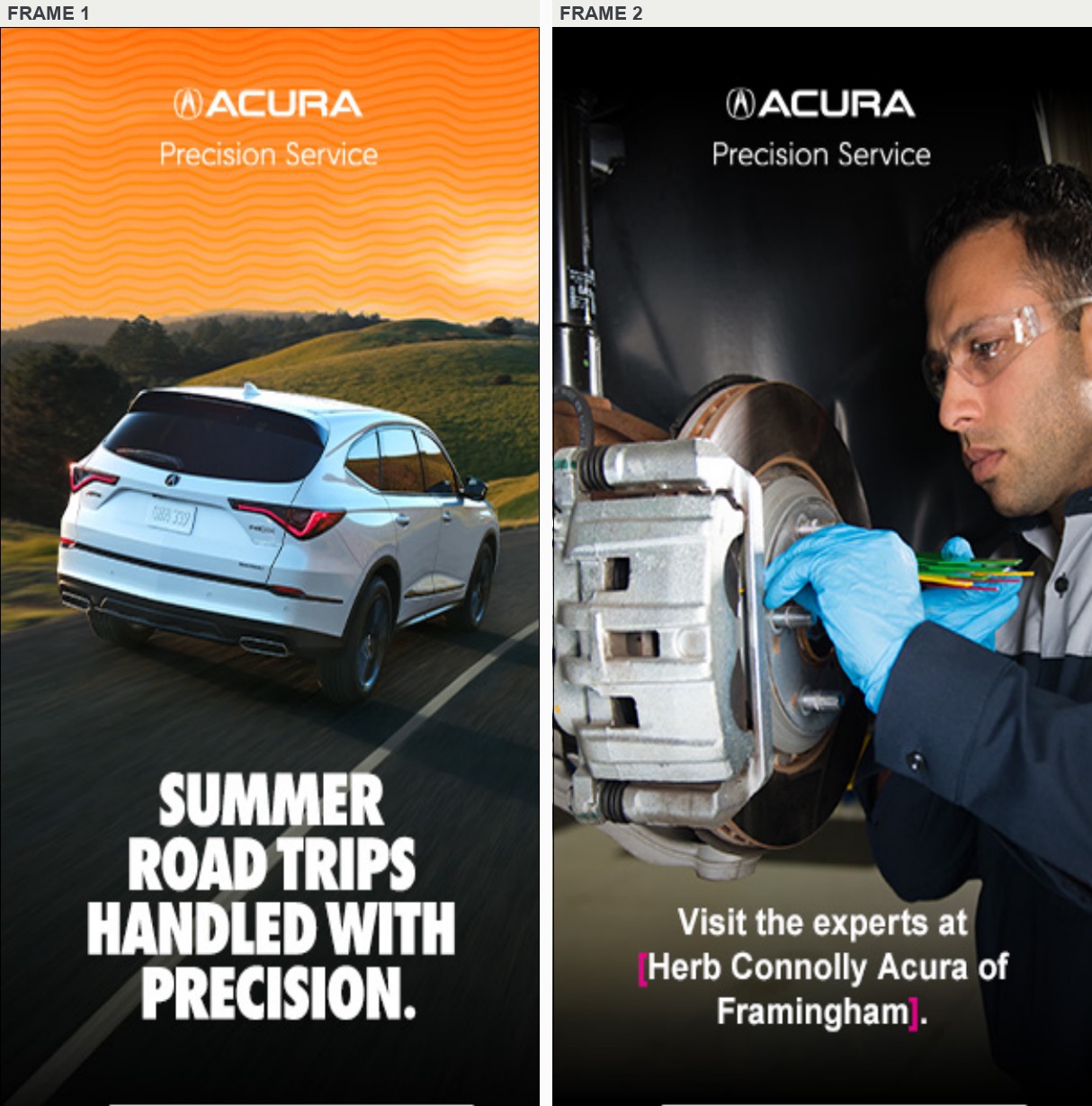
The hero concept — scenic drive-bys, an odometer that spells out the season, a fan of Acuras opening like a hand of cards.
Vacation postcards shuffling on a wood table; an MDX driving into a shimmering sunset rendered with a live SVG displacement filter.
The follow-you-around cut — deliberately 100% static, logo and offer only, engineered to the same per-dealer pipeline.
Nothing is typed into an ad by hand. Every dealership lives as one row in one CSV — the single source of truth. An AI-written, zero-dependency build script stamps each row into each master through three tokens, and writes a self-contained, trafficking-ready package per dealer. No engineering department — just a spec, a conversation, and code that ships. Change the spreadsheet, rebuild, done. Watch it work — this is live:
| DEALER_ID | DEALER_NAME |
|---|---|
| — | — |
Not one frame on this page came out of After Effects. Every ad here is code-generated HTML5 — CSS and SVG animation written with AI, light enough to live in a banner slot. The playbook is what we carried over: years of automating After Effects taught us the template-plus-spreadsheet assembly line. AI let us rebuild it without a render farm.
One master comp + one dealer CSV → a render queue stamping out per-dealer deliverables overnight. Real automation — but paid for in render-hours, gigabytes, and re-renders for every revision.
The identical idea, rebuilt as living code with AI. No render farm, no overnight queue — animation that is code, weighs kilobytes, and restamps all 18,216 files in seconds.
Four master ads, built from the client's PSDs and storyboards. A human called every creative shot — the timing, the easing, the frame the client would feel. AI wrote the code: pure CSS and SVG animation, no video, no canvas, a few hundred kilobytes each. Expert code without the expert. These are the real ads, running live. Hit replay.
A three-layer odometer — chrome chassis, five clipped letter strips, a multiply shadow — rolls the letters B-E-A-C-H into place, staggered 140 ms apart.
Three vacation postcards deal themselves onto a wood table — with a z-depth swap hidden at the shuffle's midpoint so the stack reads as physical.
Ten duplicates of one Acura, rotationally aligned at frame one, fan open counter-clockwise over six seconds — deeper layers spinning faster.
A live SVG turbulence-displacement filter shimmers the sunset — surgically clipped to the sky so the haze dies exactly at the horizon line.
Once the client approved the four 300×600 anchors, every other size was derived from them — five AI sessions building in parallel, each verifying its work against the client's storyboard before reporting done. An entire production department, running in one chair. Every tile below is a real render at true pixel size, each stamped with a different real dealership.
The client never reviewed screenshots — they reviewed a live web page: every ad running beside its storyboard frame, with a notes box under each unit. Notes saved straight to structured JSON, were applied as a batch — each fix verified against the comp before it counted — then archived. Twelve rounds, fully traceable, nothing lost in an email thread.


The taste, the storyboard reading, the call on every frame — human. Everything a studio would staff for, AI did: five agent sessions building sizes in parallel against a shared spec, a headless-browser harness freeze-framing every ad and comparing it to the client comp, client notes applied as verified batches. The animator, the production artist, the QA desk, the traffic department — one chair.
Thirty-two derivative sizes were built in one coordinated run by five AI sessions, each reading the same ground-truth spec — the document that encodes every hard-won client correction.
No change shipped on "looks right." A headless browser froze every ad at key timestamps and the render was compared against the client's storyboard — every round, every unit.
Client notes became structured JSON the moment they were typed. Batches were applied, verified, archived — twelve rounds of revisions with a complete audit trail.
A complete client-feedback round across all four hero ads — re-animated, re-verified, re-presented. One person, seventeen hours.
Not one of the 18,216 per-dealer files is hand-touched. Every package is regenerated from source — so there is nothing to proofread and no dealer #604 typo.
Dealer name, dealer ID, click URL. That's the entire contract between the creative and the data — which is why it can't drift.
Ads, listings, proposals, product pages — if you produce the same thing hundreds of times with small changes, this is for you. Human direction where it counts, an AI studio everywhere else. Expert code without the expert. One person, at scale.