STAPLEGUN » Oklahoma City2001–2020 Branding // Broadcast // Identity // Interactive // Print // Social

My first startup lasted twenty years.

STAPLEGUN was a full-service advertising agency I co-founded in my son’s bedroom in 2001 and led as CEO and creative director until 2020. It grew from two people to 48. It climbed from a bedroom to three floors of the most beautiful building in downtown Oklahoma City. It was my life for twenty years — the people I met, the careers we made, and the work on this page are what I have to show for it. All of it is real, and all of it is here.

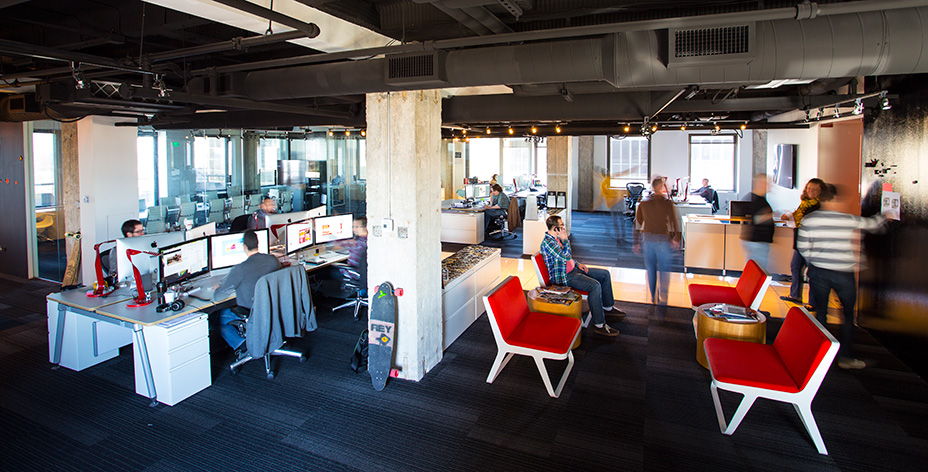
The STAPLEGUN office on the 20th floor of City Place Tower — concrete columns, red chairs, designers at work

The 20th floor of City Place Tower, downtown Oklahoma City. Concrete, red chairs, a skateboard.

2 → 48
People — from two desks in a bedroom
20
Years — my first startup, 2001–2020
2
Inc. 5000 lists — No. 1952 in 2015, No. 1529 in 2016
3
Metro 50 awards — OKC’s fastest-growing, three years running
111
Films on this page — recovered from the masters
172
Case studies — across seven disciplines
Where it started

A bedroom, two Macs,
and a code word.

In March of 2001 I walked away from a Senior VP title and set up shop in the smallest office I would ever occupy: my son’s bedroom, temporarily annexed for the cause. Two of us — me in Edmond, my co-founder Brent McCutchen down in Norman — a couple of Macs, and a name that promised we would fasten things together fast and permanently. “Staplegun” had been our code word back at Ackerman McQueen for the freelance projects we dreamed up. Now it was on the letterhead.

I had spent a decade at Ackerman — art director, then broadcast producer, then the guy who talked the agency into building websites before most clients knew what a website was. I’d built some of the first sites national brands ever had. Now I wanted to build the whole agency that thought that way: creative first, technology fluent, allergic to doing things the way they’d always been done. Our motto from the earliest days: “It’s not talking, it’s doing.”

The climb

Bedroom to skyline.

2001

The bedroom » Edmond & Norman

Two people, two bedrooms, sixty miles apart. The commute was a hallway. The conference room had a twin bed in it. Every agency says they’ll hustle for you — ours literally could not afford not to.

2005

The Colcord Building » 15 N. Robinson, Suite 901

First real office: Oklahoma City’s first skyscraper, 1909 — built in reinforced concrete because Charles Colcord had watched San Francisco burn. A two-desk operation with a downtown address and outsized nerve. We stayed until they turned the whole thing into a boutique hotel.

2007

Classen Boulevard » 6525 N. Classen

The growth office. More desks, more accounts, the first real production room. This is where the agency learned to be an agency — where “the two of us” became “the team.”

2011

City Place Tower » the 20th floor

204 N. Robinson. Built in 1931 as the Ramsey Tower — 33 stories of art deco, thrown up in nine months by the same builders as the Empire State Building. We didn’t rent the 20th floor. We bought it. Suite 2000, 4,600 square feet, the skyline in every window.


Then the 19th floor

We outgrew 20, so we leased 19 too. Two floors connected by a staircase and a skateboard-friendly stretch of polished concrete.


Then the basement

The broadcast studio went underground — a full production floor in the bones of the building. Camera bays, edit suites, red hallways. By 2016 the site read “offices in Chicago, Dallas and Oklahoma City” — 332 S. Michigan Avenue and 3720 Canton Street, if you’re keeping score — but the heart of it was always this tower: top of it, middle of it, bottom of it.

A CONFESSION

About that tower

City Place’s original fire escape was a spiral slide running the full height of the building. At 18, I talked a security guard into letting me ride it down on a Friday night — decades before the agency bought the 20th floor. Asked in 2016 why I didn’t still use it: “Today’s security guard is more of a stickler for rules. Plus, it’s too dusty.”

20 19 B
City Place Tower · 204 N. Robinson
The Classen years

6525 N. Classen, in pictures.

The office where the agency grew up: exposed duct, corrugated steel, a black wraparound couch, and the work hung big on every wall. These are the actual rooms, 2007–2011.

Account after account

The wall of brands.

At The Beach came aboard in 2003 and grew from 8 stores to 70+ across four states. The Oklahoma Department of Commerce arrived in 2004 and stayed for the duration — agency of record for the state’s own brand. The mid-2000s roster already ran fifty deep: General Motors, IBC Bank, KWTV News 9, Crowe & Dunlevy, Oklahoma Tourism, the State Fair, United Way, Duncan Regional Hospital. Then Catholic Charities (2009), OU Outreach (2010), RibCrib and Guernsey (2011), OU Medicine (2013), the Oklahoma City Thunder (2014), EMBARK (2015), Devon, Dell, EnLink, Chesapeake, the OEA… and in 2018, when Oklahoma City needed a mark for its new crown-jewel park, STAPLEGUN drew the scissortail — the Scissortail Park logo is agency work. Account after account, year after year.

The healthcare practice

OU Medicine

“Oklahoma City is Alive and Well”

2013. The biggest undertaking in the agency’s history. OU Medicine had state-of-the-art facilities, world-class physicians and Oklahoma City’s only Level 1 trauma center — and a reputation as, in the research’s own words, “the run-down hospital on the bad side of town.” Its biggest competitor was outspending it four-to-one.

Our answer tied the hospital’s story to the city’s: Oklahoma City is Alive and Well. Time-lapse film of a skyline in mid-boom. A 60-second anthem. Testimonials from real patients and the physicians who saved them. The message flexed anywhere it needed to go — “Edmond is Alive and Well,” “Millwood High School is Alive and Well.” Then we pushed it further: The Amazing Human Body in 2014, Defining Medicine after that — documentary-style films with OU’s researchers, positioning OU Medicine as the place where medicine is invented, not just practiced.

Year one: the momentum question

NRC focus groups, 2013 — “top box” share of respondents who said the hospital’s momentum is really on the way up, first quarter vs. fourth quarter of the campaign year. OU Medicine ended the year outpacing every competitor by 16.5 points.

Q1Q4
Mercy
31.4%
41.3%
SSM Health
39.3%
41.3%
Integris
26.4%
24.4%
OU Medicine
31.0%
47.5%
“Momentum is really on the way up” — % of NRC focus-group respondents, Q1 vs Q4 2013

Year two: the uniqueness question

NRC focus groups, 2014 — share of respondents who rated the hospital “very unique” compared to other area hospitals. Everyone else moved a few points. OU Medicine nearly doubled.

Q1Q4
Mercy
19.4%
20.2%
SSM Health
17.6%
23.4%
Integris
14.0%
17.6%
OU Medicine
24.2%
40.6%
“The hospital is very unique” — % of NRC focus-group respondents, Q1 vs Q4 2014

2016: research-based medicine

The goal was to position OU Medicine as a pioneer of research, not just a user of it. Perception of uniqueness responded immediately — within a single quarter:

19.9% → 46.5% Perceived uniqueness, in one quarter · NRC ticker data, 2016

The “excellent quality” top-box score started 2016 at 37.5% and reached 59% during the year. Brand score: 85.5 against a competitor average of 74.6.

And the social file

The whole program was measured — the fan base we built for OU Medicine in nine months, and the six-month engagement numbers behind it.

24,000
Facebook fans — up from 2,250, in nine months
10M
Impressions — in six months
42,000
Clicks — six months
31,000+
Engagements — six months

OU Medicine was the flagship, not the whole fleet. The healthcare practice ran from Duncan Regional Hospital — one of the agency’s earliest healthcare clients, the roots of our rural-hospital work — through the Stephenson Cancer Center (“Hope is at the Center”), The Children’s Hospital, OU Medical Center Edmond (“There’s Life in Edmond. Live it Well.”), the OU Health Sciences Center, the full rebrand of Pinnacle Healthcare into Valir Health, DLO, Delta Dental of Oklahoma and Cochlear Americas.

OU MedicineStephenson Cancer CenterThe Children’s Hospital OU Medical Center EdmondOU Health Sciences CenterValir Health Duncan Regional HospitalDLODelta Dental of OklahomaCochlear Americas
The reel

The keynote reel.

Every spot below had a serious team behind it — editors, shooters, composers, colorists, the whole broadcast floor. They were superb, and what these films look and sound like is their work. My part was the bookends: I pitched these ideas, I sold them to the client, I directed every piece… and I sat in the interview chair.

That chair mattered more than it sounds. A calm, curious conversation — not a script — is how you get a real person to say a true thing on camera. Years spent as an editor taught me to hear the moment a topic was actually captured, the take with the line worth keeping. So we cast real people instead of actors and let them talk. Coaches. CEOs. Patients. Teachers. Veterans. Hundreds of Oklahomans with no media training at all — delivering with a natural voice and real emotion no actor could fake.

That turned out to be the quiet advantage of STAPLEGUN’s TV production — the reason a spot built from a conversation could genuinely move you. The team got it beautiful. I got it in the can, and I got it on the air.

These are the keynote pieces — the ones I’d put in front of anyone. Click any card to play. The rest of the archive is one button away below.

Recovered August 2026 from the agency master drives and archived Vimeo rips. Two masters (AD Academy, Cox) were corrupted beyond repair; everything else survived.

The work

172 case studies, recovered.

Pulled from the Wayback Machine: the artwork of the whole portfolio — identity, print, branding, interactive, social. Websites in their browser chrome, brochures photographed like objects, logos on location. Click anything to see it big.

From the vault

Early STAPLEGUN, 2001–2008.

Before City Place, before the case-study machine — this is what the young agency was making. In 2004, American Bank asked us to rename and rebrand it: it became Kirkpatrick Bank, launched with the year-long “Spirit of a Champion” campaign — a local athlete, champion in their field, every month. In 2006 the Kirkpatrick Foundation asked us to help establish Oklahoma as a center of creativity; the Oklahoma Creativity Project launched in early 2008 with print, broadcast, guerrilla events and a worldwide web community. Around them: At The Beach, Dell’s D|life, Delta Dental, Griffin’s 100th birthday, and the web work that paid the rent.

STAPLEGUN does identity

Seventy marks and counting.

Beyond the case studies, the site kept a running wall of every mark the studio drew — banks, casinos, coffee, cancer centers, a chapel, a governor’s inauguration, and City Place Tower itself. Recovered in one piece.

The site itself

One color and one drawing.

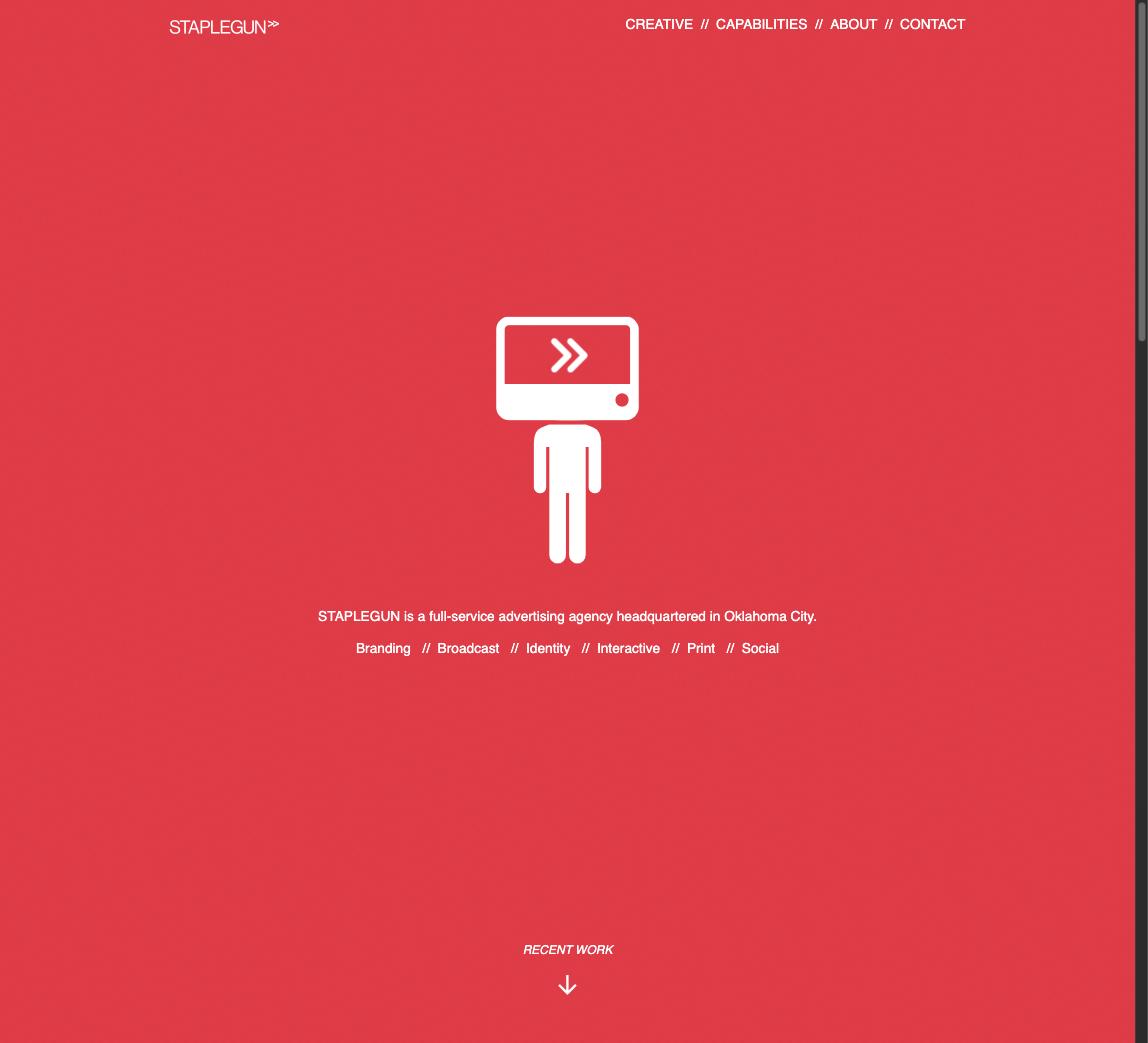
staplegun.us, 2014–2016: a flat crimson field, a line-art figure with a television for a head, one sentence, six disciplines separated by double slashes. The whole agency in a single screen — no photography, no carousel, no apologies. The domain is gone; these captures are the museum.

staplegun.us homepage, 2014 — flat red field with the white TV-head mascot
The people

It was my life for twenty years.

We grew from a meek two to 48 of the most creative, intelligent and kind people you’ll ever know. I met people who became family. We made careers. That’s the legacy.

Twenty years of paychecks, careers launched, skills learned on the 20th floor and carried all over this industry — designers who became creative directors, interns who became strategists, producers who went on to run their own shops.

Snapshots

The camera roll.

Twenty years of parties, shoots, launches and Friday afternoons. I’m still digging photos out of old drives — the empty frames below are waiting for them.

Drop files named snap-01.jpg through snap-40.jpg into staplegun/img/snapshots/ and they’ll appear here automatically.

The Robinson years

City Place Tower, 204 N. Robinson.

The last home — the 20th floor, the 19th, and the studio in the basement. This is what it looked like while it happened.

What the place was

First to move.

STAPLEGUN was never the biggest agency in Oklahoma City. It was the one that moved first — first to treat the web as a craft instead of a chore, first to put a real broadcast studio under an art-deco tower, first to tell a hospital to market itself like a city on the rise. We tore down the walls so every thought — the brilliant and the bad — could be scribbled on virtually every wall, and our philosophy was simple: work until it’s perfect. The homepage once carried a one-line joke that summed up the whole attitude: “{ Our logo is too big. }”

I resigned as CEO in the summer of 2020, nineteen years and five months after the bedroom, and the agency closed its doors for good the following year. The domain is gone now — it redirects somewhere you shouldn’t click — but the work survives in the archive, on the reels, and in the careers of everyone who passed through those three floors.

This page is the agency’s marker on the open web. Everything on it is real: the numbers are from the research decks, the films are from the masters, the screenshots are from the Wayback Machine.

Create responsibly